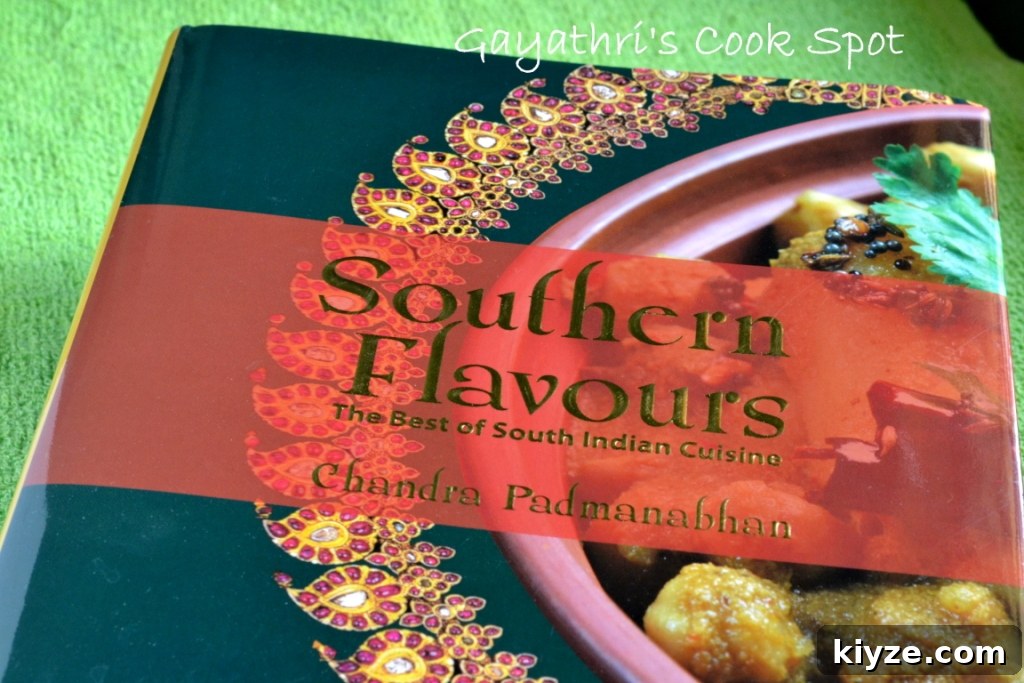
This is the author’s fourth cookbook. Her earlier title Simply South won the International Gourmand Award for Second Best Vegetarian Cookbook in 2009. She credits her mother-in-law for teaching her many South Indian techniques and family recipes.
The book begins with a personal introduction, followed by a table of measurements in both US and metric units. There is a short note on essential equipment, such as the idli stand and the paniyaram chatti, staples in a South Indian kitchen.
Recipes are organized into logical sections, making it easy to find what you need:
1. Basic Recipes
Foundational preparations such as plain rice and spice blends are covered here.
2. Sambhar and Kuzhambu
This section offers 28 varieties of kuzhambu and sambhar drawn from all four states.
3. Rasam
Twelve rasam recipes are included, with interesting regional variants such as Andhra’s kadugu chaaru.
4. Poriyal and Kootu
Twenty-six vegetable preparations—usili, palya, poriyal, thoran and kootu—are explained in detail.
5. Rice
Sixteen types of flavored rice ideal for lunchboxes, from classic lemon rice to soothing curd rice.
6. Snacks
A lively collection of idlis, dosas, vadas, bajjis, upma and bondas—snacks and breakfast favorites.
7. Sweets
Authentic, straightforward desserts like payasam, kesari, barfi and laddoo are included here.
8. Accompaniments
Chutneys and thuvaiyals that complete a South Indian meal are presented in this final section.
Each recipe is accompanied by a helpful note offering tips, variations or serving suggestions.
The author includes two suggested buffet menus ideal for a traditional South Indian spread, and six complete lunch menus combining dishes from the book—useful for planning family meals or entertaining.
The book concludes with a concise glossary that lists Tamil and Hindi equivalents for common ingredients and utensils, making it easier for cooks unfamiliar with regional terms to follow the recipes.
While I was already familiar with many Tamil classics, the recipes from other states expanded my repertoire and were especially valuable. For anyone interested in regional South Indian cooking, this book is a worthwhile read. It’s also a practical guide for newcomers to the kitchen who want reliable, authentic recipes.
I prepared several dishes from the book, following the instructions exactly. Measurements and techniques were accurate, and the results were excellent—well-balanced flavors and consistent texture. The recipes are easy to follow and well suited to home cooks.
Some of the recipes I tried from the book:
Disclosure: I was not paid for this review. This write-up was prepared as part of a book review program.